The Four Forces
What are the four forces acting on the aircraft in flight?
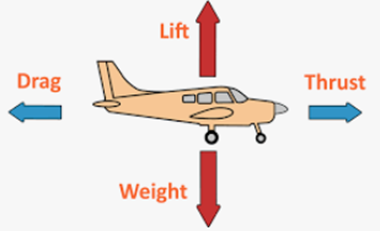
The four forces acting on an aircraft are Thrust, Drag, Lift and Wight.
Thrust
Trust is the forward force produced by the powerplant/propeller. For an aircraft to start moving, thrust must be exerted and be greater than drag. The aircraft continues to move and gain speed until thrust and drag are equal.
Drag
Drag is the rearward force caused by disruption of airflow by the wing, rotor, fuselage, and other protruding objects. As a general rule, drag opposes thrust and acts rearward parallel to the relative wind.
There are two basic types: parasite drag and induced drag. The first is called parasite because it in no way functions to aid flight, while the second, induced drag, is a result of an airfoil developing lift.
There are three types of parasite drag: form drag, interference drag, and skin friction.
Form Drag
Form drag is the portion of parasite drag generated by the aircraft due to its shape and airflow around it. Examples include the engine cowlings, antennas, and the aerodynamic shape of other components. Form drag is the easiest to reduce when designing an aircraft. The solution is to streamline as many of the parts as possible.
Interference Drag
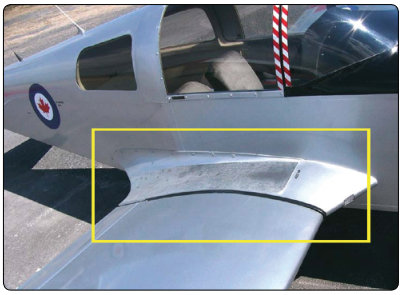
Interference drag comes from the intersection of airstreams that creates eddy currents, turbulence, or restricts smooth airflow. For example, the intersection of the wing and the fuselage at the wing root has significant interference drag. The most interference drag is observed when two surfaces meet at perpendicular angles.
Skin Friction Drag
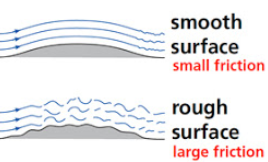
Friction Drag, also known as Skin Friction Drag, is drag caused by the friction of a fluid (Air) against the surface of an object that is moving through it.
Induced drag
Induced drag is created as a result of lift. As your wing passes through the air, an area of lower air pressure is formed on the top of the wing. Higher-pressure air below the wing seeks equilibrium with the lower pressure area above, resulting in a vortex flow from the bottom of the wing to the top. These vortices change the direction and speed of the airflow behind the trailing edge of the wing. The airflow deflects downward, which is called downwash.
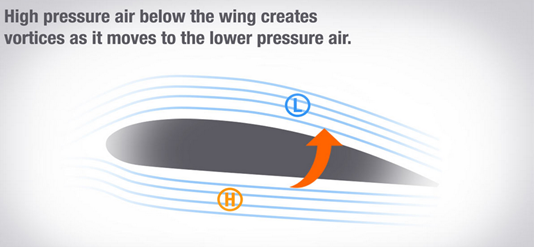
Induced drag is inherent whenever an airfoil is producing lift and, in fact, this type of drag is inseparable from the production of lift. Consequently, it is always present if lift is produced.
| Type | Description |
|---|---|
| Parasite Drag | No way functions to aid flight. |
| Form Drag | Generated by the aircraft due to its shape and airflow around it. |
| Interference Drag | Caused by the intersection of airstreams, creating eddy currents, turbulence, or restricted smooth airflow. |
| Skin Friction Drag | Caused by the friction of air against the surface of an object moving through it. |
| Induced Drag | Created as a result of lift. |
Lift
Lift is a force that is produced by the dynamic effect of the air acting on the airfoil, and acts perpendicular to the flight path through the center of lift (CL) and perpendicular to the lateral axis. In level flight, lift opposes the downward force of weight.
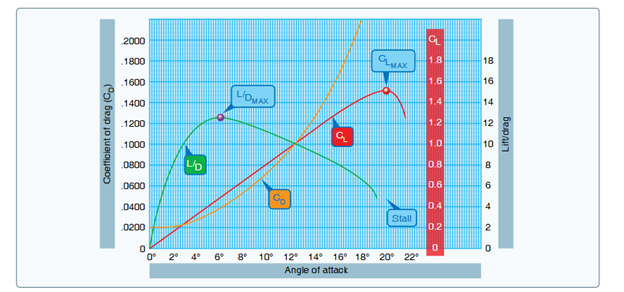
The pilot can control the lift by controlling the angle of attack AOA. As the AOA increases, lift increases (all other factors being equal). When the aircraft reaches the maximum AOA, lift begins to diminish rapidly. This is the stalling AOA, known as critical AOA.
Lift/Drag Ratio
The lift-to-drag ratio (L/D) is the amount of lift generated by a wing or airfoil compared to its drag. A ratio of L/D indicates airfoil efficiency**. Aircraft with higher L/D ratios are more efficient than those with lower L/D ratios**. In unaccelerated flight with the lift and drag data steady, the proportions of the coefficient of lift (CL) and coefficient of drag (CD) can be calculated for specific AOA.
Weight
Weight is a force that pulls the aircraft downward because of the force of gravity. It opposes lift and acts vertically downward through the aircraft’s center of gravity (CG).